
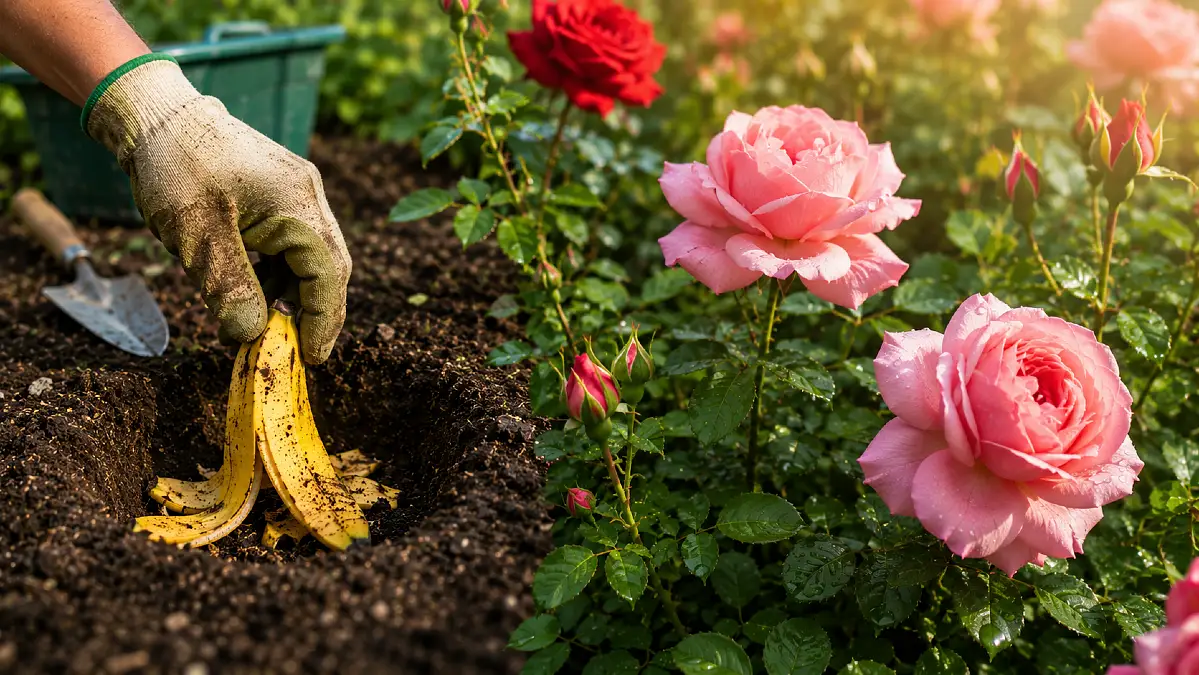
Your rose looks healthy enough, but it is not doing much.
The leaves may seem pale. New stems are growing slowly. Buds appear, then stop developing. You may be tempted to bury a banana peel beside the plant and wait for a sudden burst of flowers.
This popular garden trick sounds reasonable. Bananas contain potassium, and roses need potassium along with other nutrients. But a fresh peel cannot feed rose roots the moment it enters the soil.
So what happens after two weeks?
The peel will probably start decomposing. Soil organisms may begin feeding on it. Your rose, however, may look almost the same.
What a Banana Peel Really Adds to Rose Soil
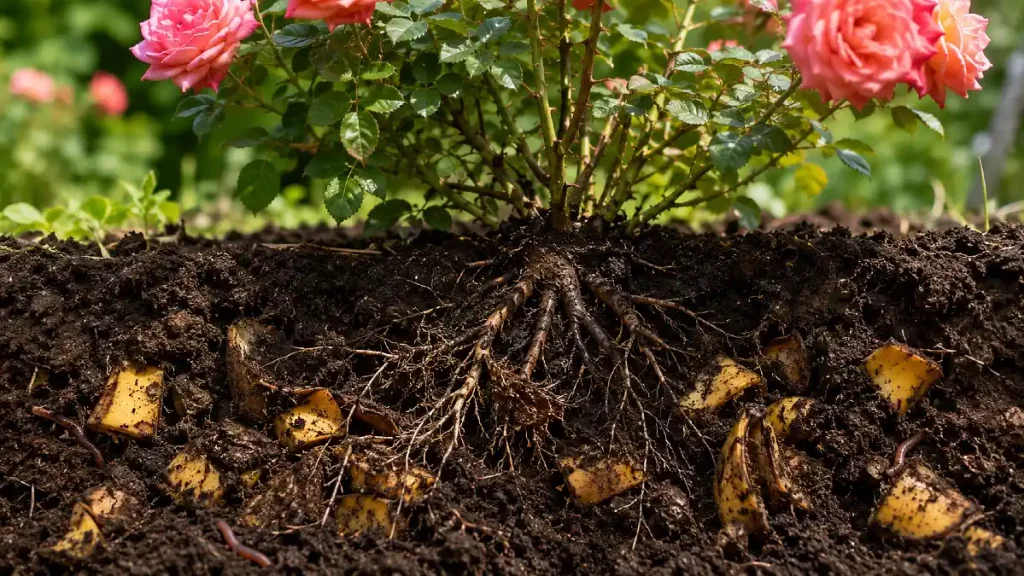
A banana peel contains organic material and small amounts of plant nutrients. Potassium gets most of the attention, but the peel is not pure potassium and it is not a balanced rose fertilizer.
Roses need several nutrients. Nitrogen supports leafy growth. Phosphorus plays a role in roots and plant energy. Potassium supports many plant functions, including water balance and stress response.
Penn State Extension explains that nitrogen, phosphorus, and potassium are the three main nutrients commonly listed on fertilizer labels and soil test reports. A plant can suffer when one is low, but adding more of a nutrient that is already present may not help.
A fresh peel also does not release all its nutrients at once.
Microbes, fungi, and small soil organisms must break the material apart. The nutrients then need to move into the soil water before roots can take them up.
The Royal Horticultural Society says banana skins can be added directly to soil, but recommends chopping or tearing them into smaller pieces to speed decomposition. It still describes composting as the best general use for old banana skins.
That means one peel acts more like a tiny compost ingredient than a full feeding.
What You May Notice After 2 Weeks
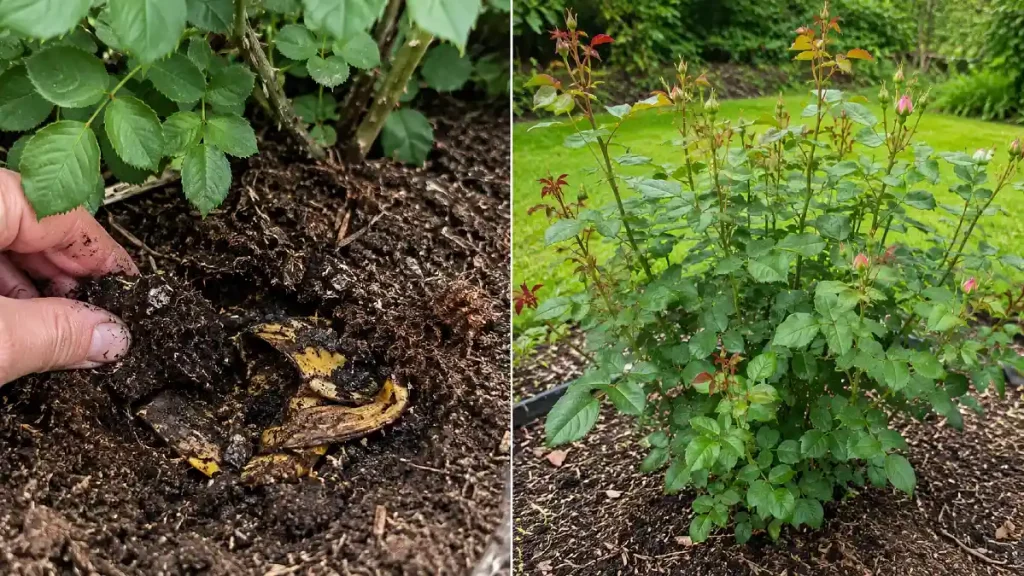
After two weeks, the clearest change may be happening underground.
The peel may become soft, brown, and partly broken down. Its exact condition will depend on the soil.
Breakdown is usually faster when the soil is:
- Warm
- Moist but not soaked
- Rich in soil life
- In contact with small pieces of peel
Breakdown may be slower in cold, dry, compacted, or very sandy soil.
You may also see no clear change in the rose itself. That is normal.
A fresh banana peel does not work like liquid fertilizer. The nutrients must first be released by decay. Even after that begins, one peel supplies a small and uncertain amount.
A rose may produce a new leaf or open a bud during the two week test. But that does not prove that the banana peel caused it.
The change could come from:
- Warmer weather
- Better sunlight
- Recent rain
- Regular watering
- Nutrients already stored in the plant
- Fertilizer applied weeks earlier
- Normal growth for that rose variety
This is why photos and a control plant matter. Without a comparison, normal growth can look like proof of a garden trick.
Do not expect one buried peel to double the number of blooms within fourteen days. There is no reliable reason to promise that result.
Why a Banana Peel Cannot Feed a Rose Right Away
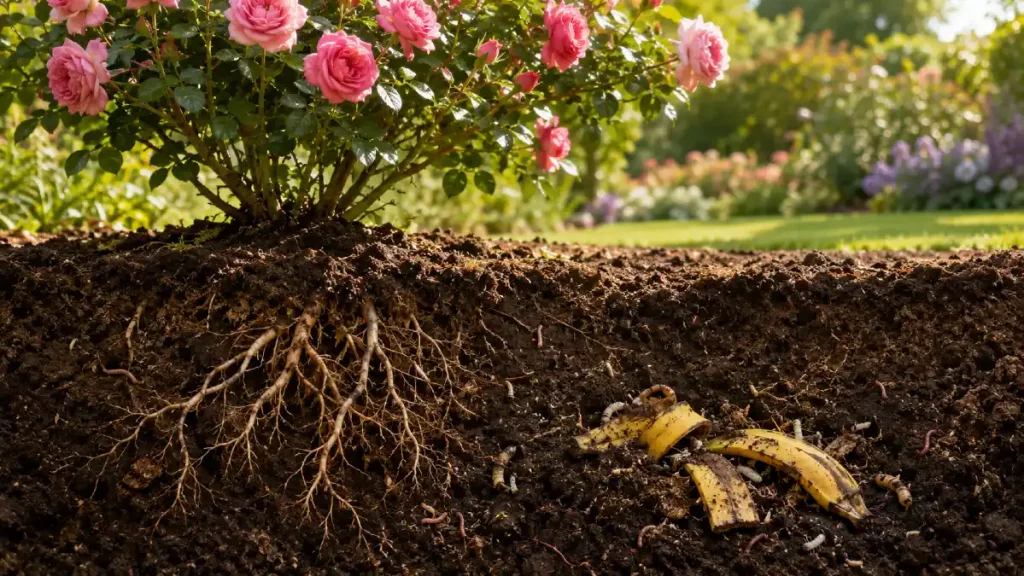
Rose roots do not bite into the peel or pull food directly from it.
Roots absorb mineral nutrients that are dissolved in soil water. Before most of the nutrients in a fresh peel can reach the roots, soil life must break down the peel’s tissues.
This takes time.
A whole peel can remain in the soil much longer than chopped pieces because microbes have less exposed surface to work on. Cutting the peel into small squares gives them more edges and surfaces to reach.
Water also matters. A dry peel decomposes slowly. A peel sitting in soaked soil may become slimy and produce an unpleasant smell.
Temperature makes a difference too. Soil life is often more active in warm conditions than in cold ground.
This explains why the same trick may appear to work quickly in one garden and do very little in another.
The peel is not behaving like a measured fertilizer dose. It is becoming part of a natural decay process.
How to Bury a Banana Peel Without Harming the Rose
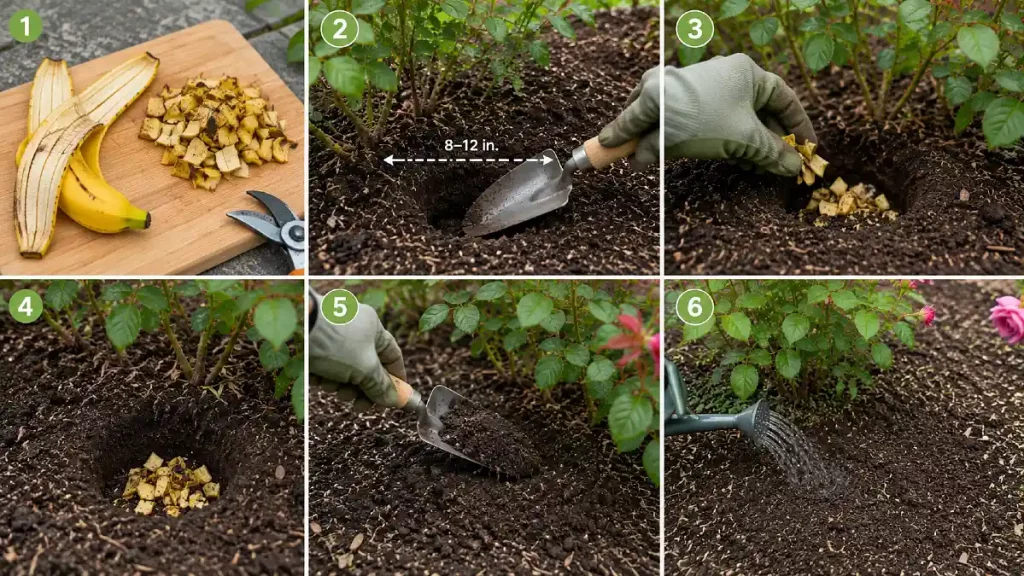
You can try the method, but placement matters more than most social posts suggest.
Do not dig directly beside the rose stem. The thick crown and major roots are in that area. Cutting or scraping them can cause more harm than the peel can fix.
Use this safer method.
1. Start With One Peel
One peel is enough for a simple test.
Using several peels in one small hole creates a large pocket of wet food waste. It may smell, attract animals, or break down without enough air.
2. Cut It Into Small Pieces
Use kitchen scissors or a knife to cut the peel into pieces about one inch wide.
Smaller pieces mix with the soil more easily. They also decompose faster than one folded peel.
3. Dig Away From the Main Stem
Move about 8 to 12 inches from the base of a medium rose bush.
Choose a spot near the outer part of the plant rather than directly against its crown. Dig carefully so you do not slice through thick roots.
4. Make a Hole 4 to 6 Inches Deep
Place the peel pieces in the bottom of the hole.
This depth helps hide the scent and keeps the scraps away from the soil surface. Do not dig deeper if you begin hitting major roots.
5. Cover Every Piece
Return the soil to the hole and press it down gently.
No yellow peel should remain visible. The RHS also advises keeping banana skin pieces beneath soil or mulch where they can decay out of sight.
6. Water Normally
Water the rose based on soil moisture, not because you added a peel.
Do not keep the area soaked. Roses need moisture, but constantly wet soil can limit air around roots.
4 Problems the Banana Peel Trick Can Cause
Burying one peel is unlikely to ruin a healthy garden. Still, the method has downsides that are easy to miss.
1. Animals May Dig Up the Soil
Dogs, rodents, raccoons, and other animals may notice the scent of decomposing fruit.
A shallow peel is easier to find. An animal digging for it can expose roots or break new shoots.
Cover the scraps fully. Stop using the method if your garden already has frequent animal activity.
2. Exposed Pieces May Attract Insects
A peel left on top of the soil can attract flies and other creatures interested in decaying food.
Some garden animals feed mostly on rotting material. The RHS notes that many slugs and snails are drawn to decaying matter, even though only some species cause serious plant damage.
A fully buried peel presents less of a problem than one used as surface mulch.
3. Too Many Peels Can Create a Wet Pocket
A thick pile of fruit scraps may hold water and limit air inside the hole.
That does not mean a single peel is dangerous. It means more is not always better.
Spread small amounts of organic material through a compost pile rather than packing many scraps against one plant.
4. The Trick May Hide the Real Problem
This is the greatest risk.
A rose with weak growth may need more sun. It may be too dry, planted too deeply, crowded by nearby roots, or affected by insects or disease.
Penn State Extension recommends good sunlight, drainage, and air circulation as basic parts of healthy rose care and disease prevention.
A banana peel will not correct poor drainage, deep shade, black spot, damaged roots, or irregular watering.
A Better Way to Use Banana Peels for Roses
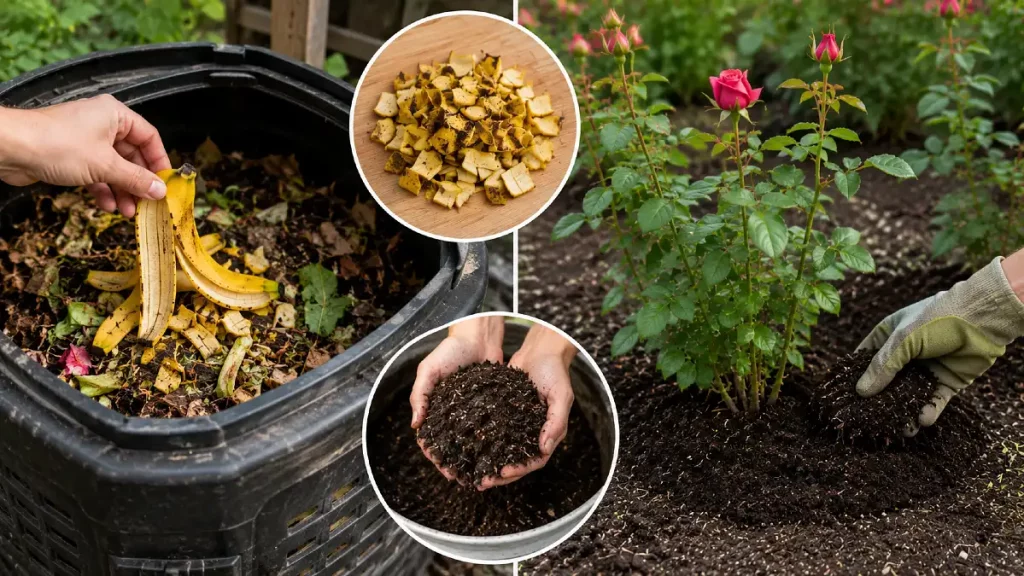
The best place for a banana peel is usually the compost pile.
Composting combines food scraps with leaves, dry stems, paper, and other materials. Over time, those items turn into a more even soil amendment.
The Royal Horticultural Society recommends adding banana skins to compost and cutting them into pieces to speed the process. Finished compost can then be used as a soil improver or mulch.
This approach offers several benefits.
- The peel is already partly broken down before it reaches the rose.
- Nutrients are mixed with many other organic materials.
- Finished compost is easier to spread across the root area.
- Food scraps are less likely to be dug up.
- Compost helps soil structure and water holding ability.
Spread a thin layer of finished compost over the soil around the rose. Leave a small open space around the main stems.
Do not mound wet compost against the crown.
Compost is still not a guaranteed cure for a nutrient shortage. But it is a more practical way to turn banana peels into useful garden material.
When Your Rose Needs Real Fertilizer Instead
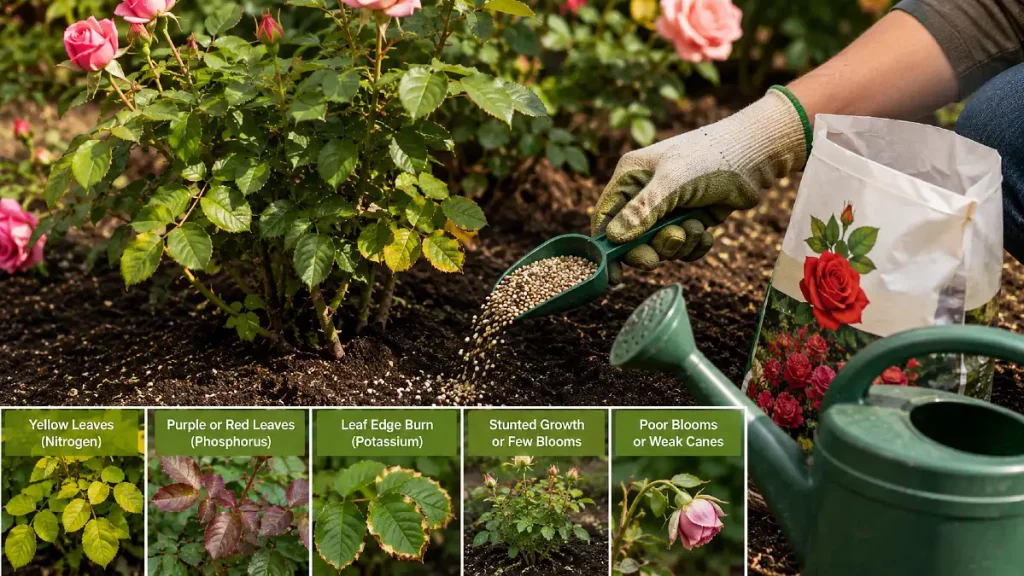
A banana peel is too slow and too uncertain when a rose has a true nutrient shortage.
Start by checking the growing conditions.
Ask these questions:
- Does the rose receive at least several hours of direct sun?
- Does water soak into the soil instead of collecting around the crown?
- Has the soil become very dry between waterings?
- Are leaves damaged by spots, insects, or mildew?
- Is the rose competing with a tree or large shrub?
- Has any fertilizer already been applied this season?
Next, consider a soil test.
Penn State Extension describes soil testing as a tool for measuring fertility and finding suitable lime and fertilizer needs. Its reports can show levels of phosphorus, potassium, calcium, and magnesium, along with soil acidity.
This matters because potassium may already be high enough. Adding more will not fix a nitrogen shortage or a watering problem.
When feeding is needed, choose a fertilizer labeled for roses or flowering shrubs. Look for a product that supplies more than one main nutrient.
Apply it exactly as the label directs.
Do not guess at the amount. Extra fertilizer can damage roots, waste money, and allow nutrients to move away from the garden in water.
A measured fertilizer offers a more predictable result than burying kitchen waste.
Try This Simple 2 Week Banana Peel Test
A small comparison can help you judge the method more clearly.
Use two similar rose bushes growing in the same part of the garden. They should receive similar light and water.
Then follow these steps:
- Take clear photos of both roses on the same day.
- Count visible buds and new leaf clusters.
- Bury one chopped banana peel near the first rose.
- Add nothing near the second rose.
- Give both plants the same amount of water.
- Do not add any other fertilizer during the test.
- Take new photos after fourteen days.
- Compare leaf growth, bud count, pests, odor, and disturbed soil.
You can also uncover one small section of the burial spot to see how much of the peel remains. Cover it again when you finish.
Do not use one open flower as proof. A bud that was already formed may have opened with or without the peel.
The most likely result is modest: the peel begins decomposing while the two roses remain fairly similar.