
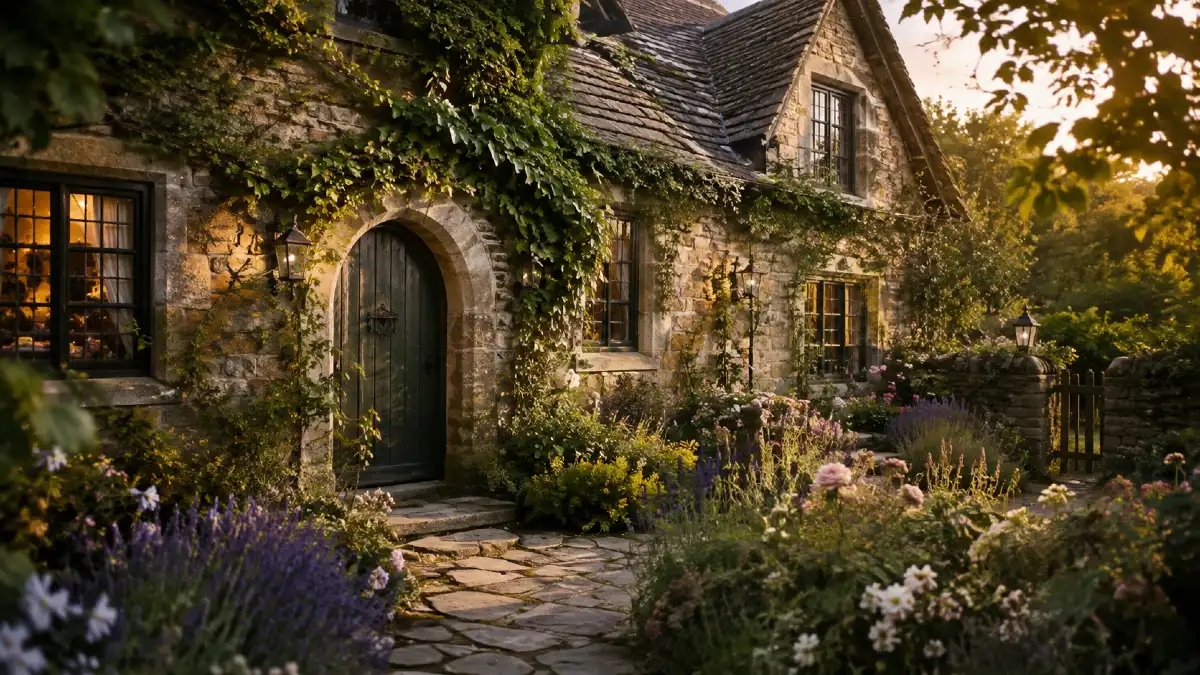
Your home can have good furniture, fresh paint, and nice decor and still feel like something is missing.
Usually, the missing piece is character.
The cottages that stay in your mind rarely depend on expensive furniture. Their charm comes from deeper details. A rounded doorway changes the shape of a plain wall. Old looking beams add warmth overhead. Ivy softens stone. A deep window becomes a place where you actually want to sit with a book.
That is the secret behind many memorable storybook cottages.
You do not need to copy every feature. In fact, you probably should not. A normal home can start to feel forced when every room is filled with rustic decor.
Instead, choose the ideas that make sense for your architecture.
Here are 14 cottage scenes worth studying, from the ivy wrapped facade to the warm glow that appears through the windows after sunset.
1. Use Ivy to Make a Stone Cottage Feel Established
Start outside.
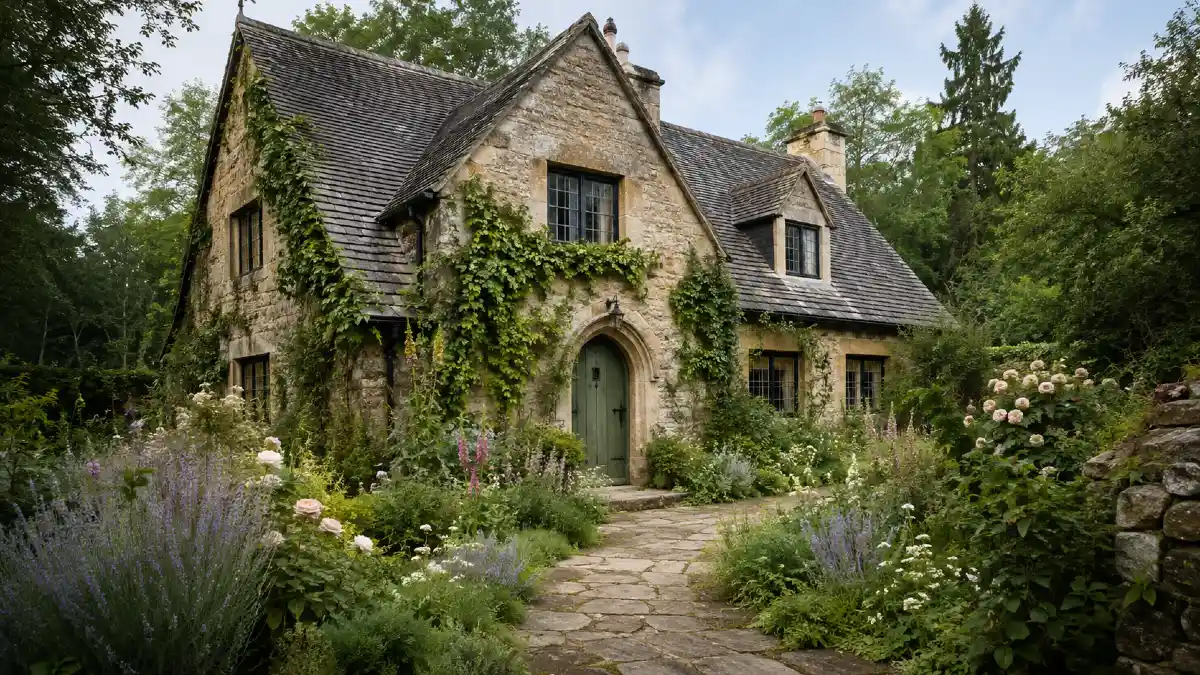
An older looking cottage often feels connected to its garden rather than placed in the middle of it. Climbing greenery is one of the easiest ways to create that connection.
The key is restraint.
You still want to see the beautiful limestone, windows, roof, and arched entrance. Let ivy move across selected areas of the facade instead of hiding the whole house.
This gives you texture while keeping the architecture clear.
Ivy also needs maintenance. The Royal Horticultural Society recommends keeping growth away from gutters, windows, roofs, chimneys, and weak or damaged masonry. Mature growth can become heavy, especially on vulnerable structures.
So copy the romance, but keep control of the plant.
For a similar look without attaching ivy directly to delicate walls, you can grow suitable climbing plants on separate supports. RHS guidance suggests placing climber supports roughly 5 cm from a wall so plants have space to grow.
2. Give the Entrance an Arched Wood Door
A rectangular front door can disappear into a facade.
An arched door rarely does.
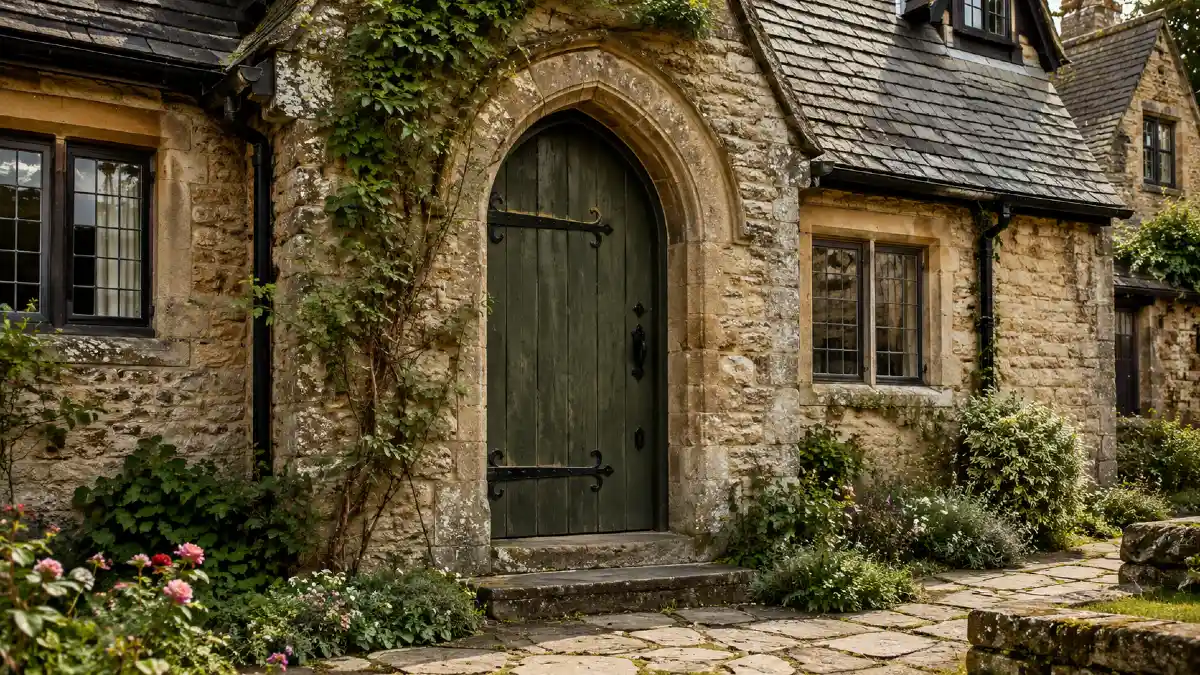
That curve immediately breaks up straight walls and gives the entrance a softer shape. It works especially well with thick stone because the opening feels carved into the house rather than attached to it.
Keep the door simple.
A solid oak door painted dark olive green works beautifully against warm limestone. Add black iron hinges, a modest handle, and one small window if you need extra light.
Then stop.
Too much decorative hardware can turn a believable cottage entrance into a themed set.
The stone arch and door shape already provide most of the character.
You can repeat the curved form once or twice inside with a doorway, cabinet opening, or small wall niche. Repetition helps the original arch feel intentional.
3. Let Exposed Wood Beams Carry the Interior
Once you step inside, the ceiling can do much of the decorating for you.
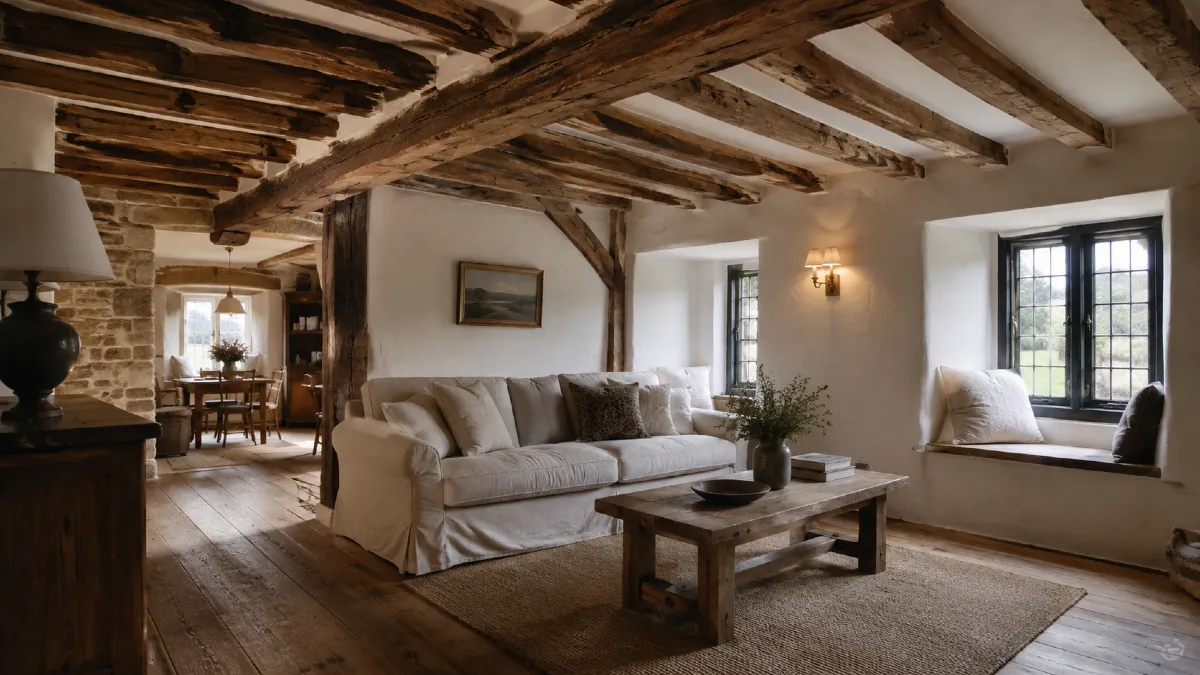
Exposed wood beams bring depth to a room before you add a single picture or pillow. That is useful in a cottage because the goal is warmth without clutter.
Use medium or dark oak against warm white plaster. The contrast lets you see the structure clearly while keeping the room bright. You do not need beams across every inch of ceiling. A few strong structural lines usually look more believable.
Architectural Digest has shown historic restorations where old beams were kept visible because they were part of the property’s original character.
That is a good lesson even if your beams are newer.
Treat them like architecture instead of decoration.
Keep the nearby furniture simple. Linen upholstery, wood tables, woven baskets, and quiet rugs allow the ceiling to remain the main event.
4. Turn a Deep Window Into a Reading Seat
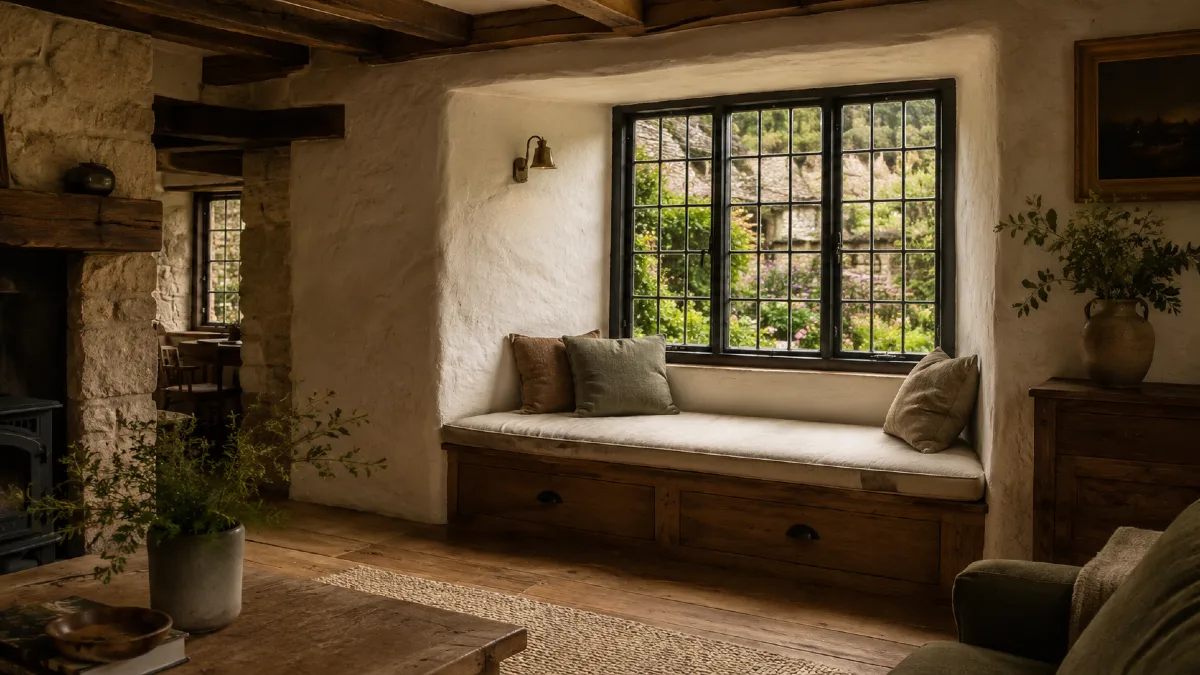
Thick cottage walls create something modern construction often loses: deep windows.
Use that depth.
A built in window seat gives you a useful place to read while making the architecture feel much richer.
You do not need a mountain of cushions.
One long seat cushion in oatmeal linen and two small pillows are enough. Add drawers beneath the bench if storage matters.
The window itself should remain the focus.
A deep black framed leaded window surrounded by warm plaster creates plenty of detail. You can soften it with simple linen curtains if privacy is needed.
Place a small wall sconce nearby and you have a reading spot that works after sunset too.
This is also a good cottage idea for a normal house. Even if your wall is shallow, cabinetry can be built around a window to create the look of a deeper recess.
5. Make a Stone Fireplace the Living Room Anchor
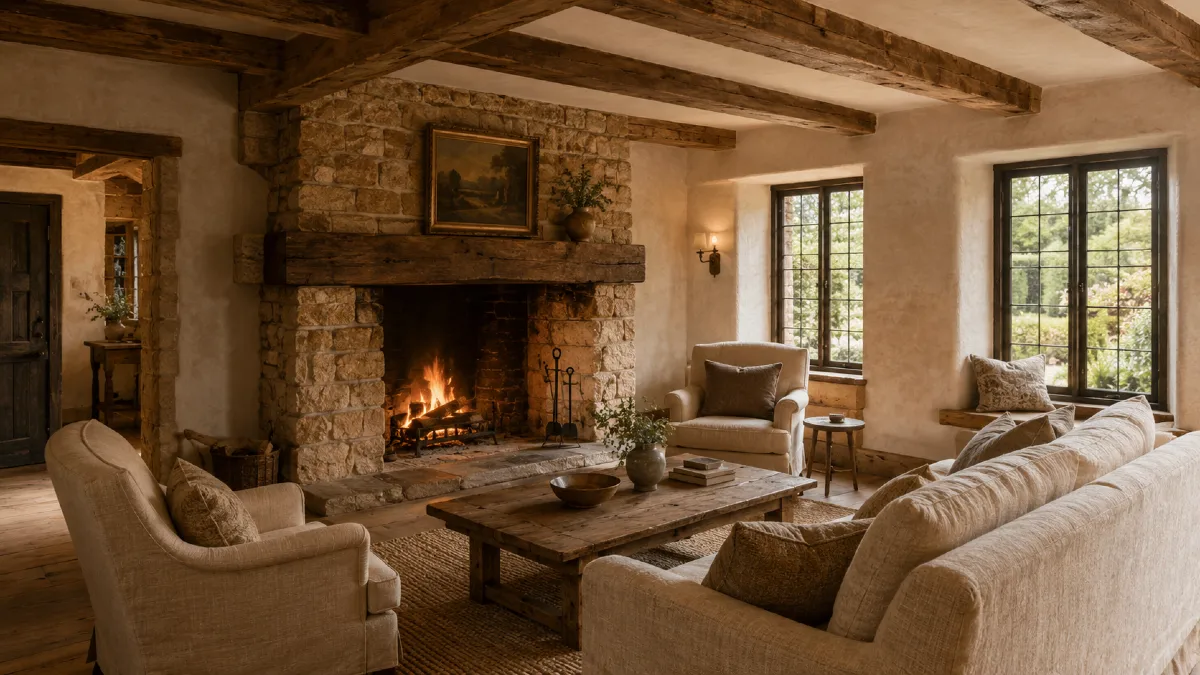
If your living room has one strong focal point, decorating becomes easier.
For this cottage, make it the fireplace.
Use the same warm stone seen on the exterior so the material feels connected to the house rather than added later.
A chunky reclaimed oak mantel is enough. You do not need rows of accessories across it.
Try one old framed landscape, a pair of candlesticks, or a small piece of pottery. Then arrange the seating around the fire. This creates a room that feels made for conversation instead of television.
The stone should not look perfectly uniform. Small changes in size, tone, and texture help it feel older.
If a full stone fireplace is outside your budget, focus on the visible surround and hearth. Even a smaller amount of real stone can carry more visual weight than covering every wall with rustic decoration.
6. Use a Soft Country Kitchen Instead of a Perfect Show Kitchen
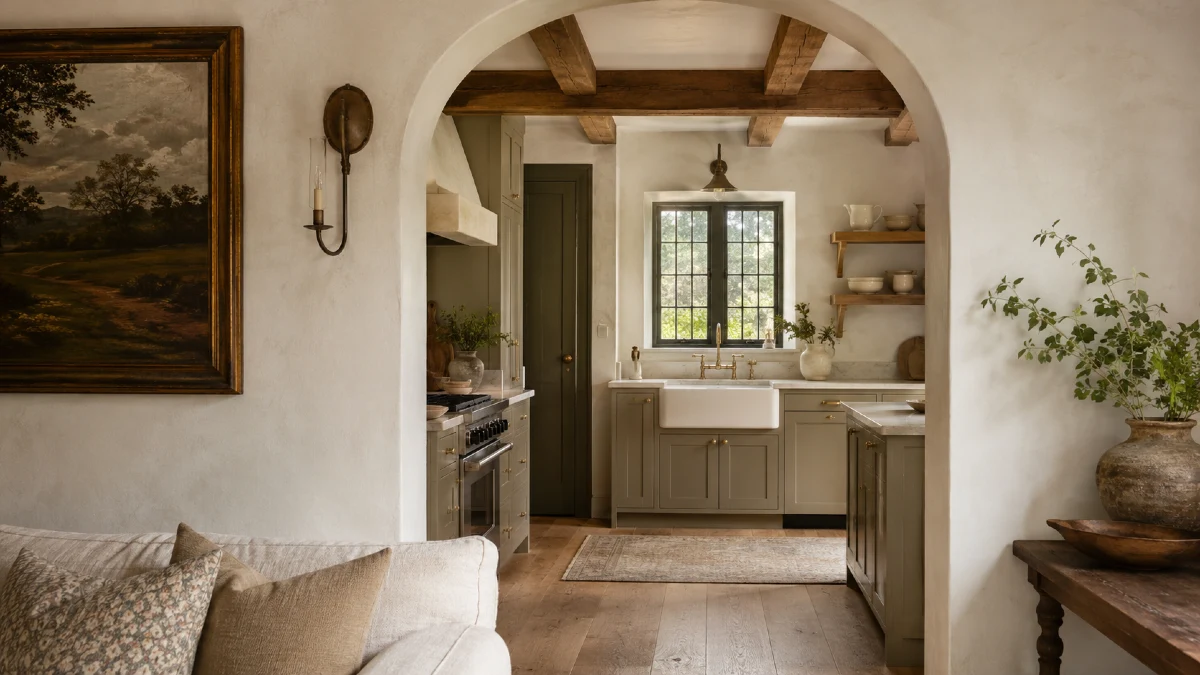
Cottage kitchen should feel comfortable enough to use. That means some softness is welcome.
Try painted cabinets in a muted cream, warm tan, or gentle green. Pair them with aged oak, quiet stone counters, brass hardware, and a deep ceramic sink.
Current paint collections make this palette easy to build.
Sherwin Williams named Universal Khaki SW 6150 its 2026 Color of the Year and describes it as a warm neutral.
Benjamin Moore’s 2026 palette includes Swiss Coffee OC 45, Sherwood Tan 1054, Narragansett Green HC 157, Southwest Pottery 048, and the much deeper Silhouette AF 655.
You could use Swiss Coffee on the walls, Sherwood Tan or Universal Khaki on cabinets, and Narragansett Green on a pantry door.
Do not make every surface look aged.
Modern appliances and practical storage can stay. The room simply needs enough natural material and softer color to stop it from feeling clinical.
Open shelving can help, but keep it limited to things you actually use.
7. Create a Breakfast Nook That Feels Tucked Away
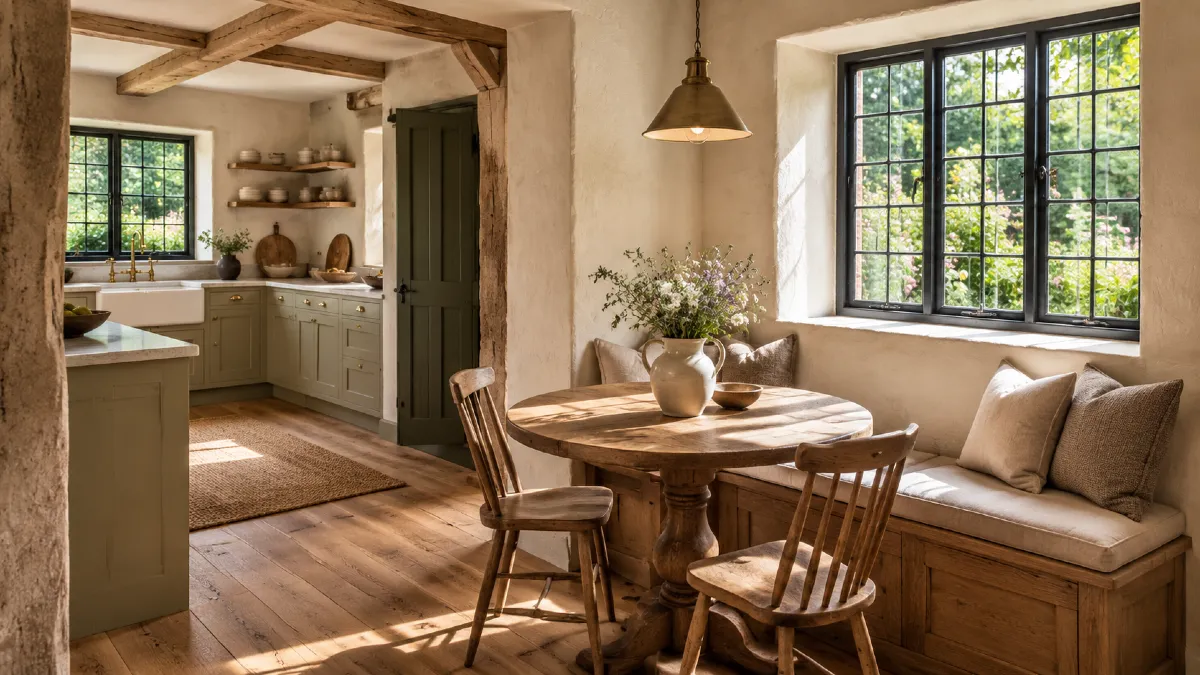
Large dining rooms are useful. Small breakfast nooks are memorable. Place a built in bench below a deep cottage window and add a small round oak table. Two simple chairs complete the setting.
The point is intimacy.
You want the nook to feel slightly separate from the main kitchen without needing another room.
A low pendant helps define that zone.
Use linen or cotton cushions that can actually handle breakfast spills. Cottage style should never make daily life harder.
Keep the tabletop mostly clear. Fresh garden flowers, one ceramic bowl, or a small lamp is enough. The window provides the rest.
This type of nook works especially well in a corner that might otherwise be filled with another cabinet or a piece of furniture nobody uses.
8. Give the Bedroom a Sloped Ceiling and Visible Beams
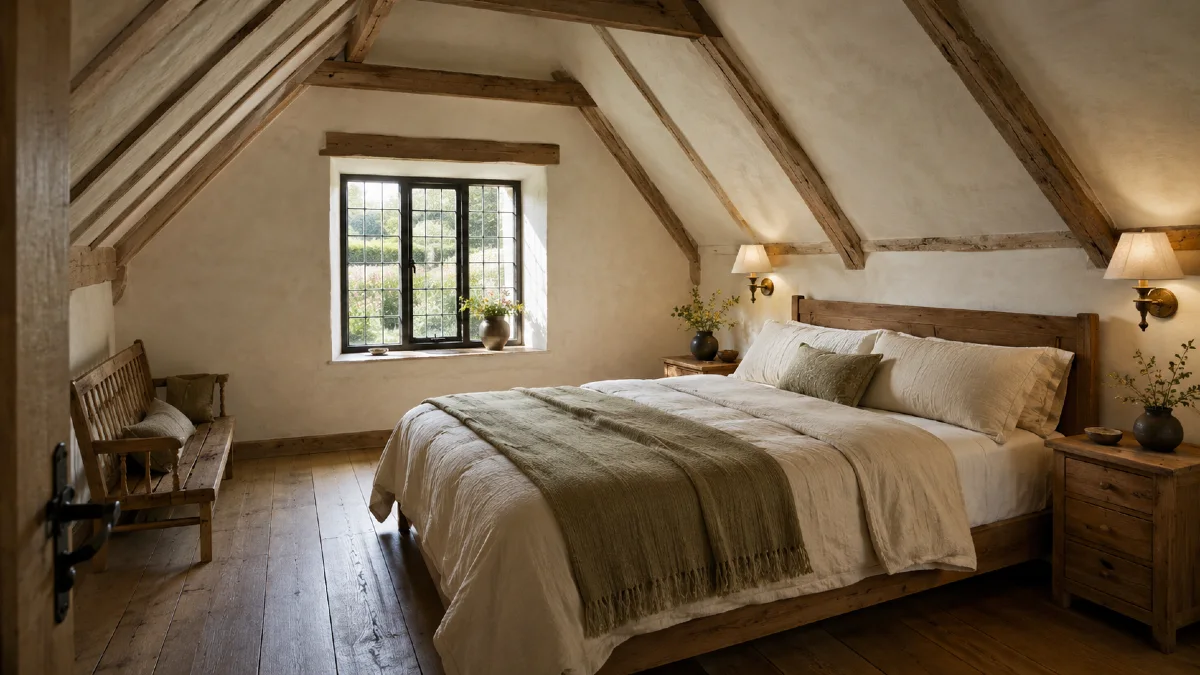
A sloped ceiling is often treated like a problem. In a cottage bedroom, it can be the best part of the room.
Keep the bed beneath the taller section so you can move around comfortably. Let lower areas hold a bench, drawers, or a small chair.
Then leave the roof shape visible.
Exposed beams give the eye something to follow and make the room feel connected to the building itself. Choose quiet bedding.
Cream linen, faded green, soft brown, and muted floral details fit the setting without turning the bedroom into a costume.
Low furniture helps too. A pair of small oak bedside tables will usually work better than large polished cabinets.
And do not cover every wall.
A cottage bedroom benefits from empty plaster because it gives the beams, windows, fabrics, and wood room to breathe.
9. Use Earthy Paint Instead of Bright White Everywhere
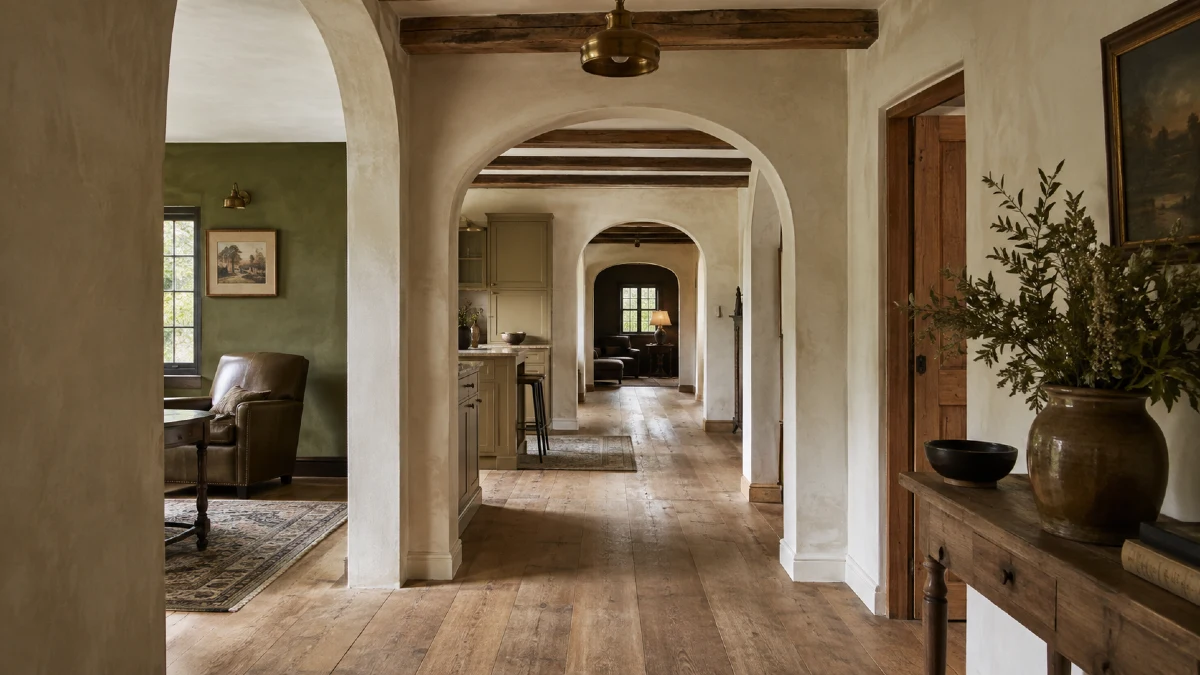
White still has a place in cottage interiors. It just does not need to cover everything.
Warm cream, mushroom, muted olive, clay, tan, chocolate, and softened blue can make a cottage feel layered without making it dark.
Benjamin Moore’s 2026 palette mixes pale shades with deeper earthy colors, including Swiss Coffee, Sherwood Tan, Narragansett Green, Southwest Pottery, and Silhouette.
Sherwin Williams’ 2026 Colormix forecast also explores complex neutrals along with richer dark families. Use deeper color where it can make a small space feel intentional.
A pantry, library, mudroom, or compact powder room can often handle more color than a large living room.
Always test first.
Sherwin Williams offers digital visualizing tools for uploading a photo and previewing paint on your own space.
Benjamin Moore provides a similar Personal Color Viewer for testing colors on uploaded room photos.
Screens are useful for narrowing choices, but finish with a real sample in the room.
10. Make the Bathroom Feel Old Without Making It Impractical
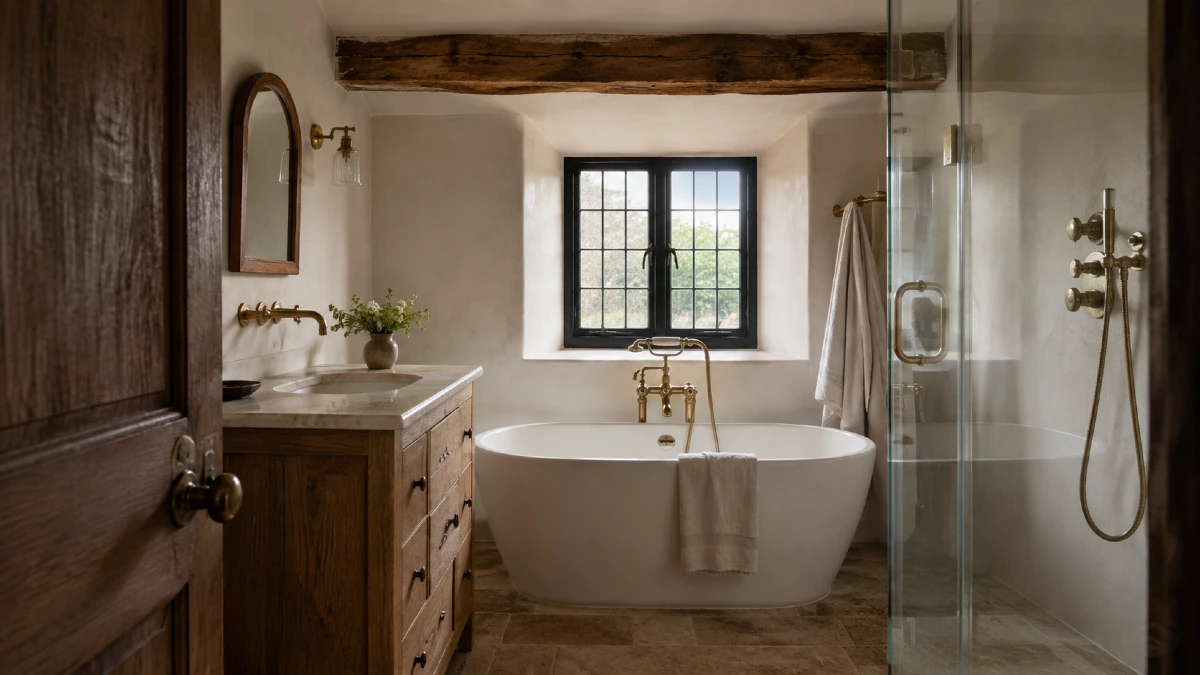
You can give a bathroom age and character without giving up modern plumbing.
Start with the surfaces. A warm stone floor immediately gives the room weight. Add limewashed walls, an oak vanity, and aged brass fittings. Then choose one traditional shape.
Freestanding tub works well if space allows. In a smaller bathroom, let the sink or mirror carry that role instead.
Keep the shower simple. Clear glass is usually quieter than a heavy framed enclosure, which allows the stone and plaster to remain visible. Storage still matters.
Closed oak vanity can hide modern products and cleaning supplies so the room stays calm. Balance matters across the whole cottage. House can look old while working like a modern home.
That is much easier to live with than copying every inconvenience of an actual historic bathroom.
11. Add Lantern Style Lighting Around the Entry
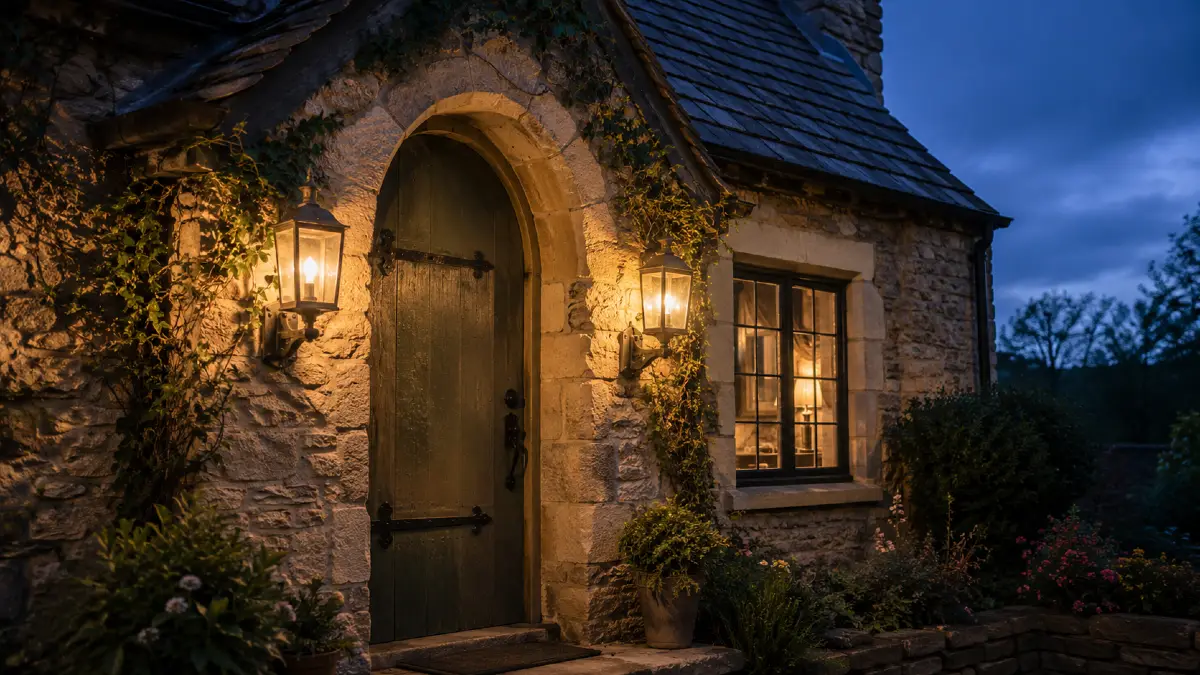
Good exterior lighting should help you see the entrance. It should also look good when the light is off. Simple lantern shape does both.
Choose aged brass, dark bronze, or blackened metal with clear glass. These materials sit comfortably beside limestone, oak, slate, and ivy.
Scale matters.
A tiny fixture can disappear against thick stone.
Schoolhouse’s 2026 outdoor lighting guidance recommends placing wall sconces around useful eye level and leaving enough room between the fixture and door frame. Its guide gives roughly 66 to 72 inches above the finished floor as a common starting range and advises at least 6 inches from the door frame where possible.
Weather exposure matters too.
Schoolhouse advises using damp rated fixtures for protected areas and wet rated fixtures where rain or snow can hit the fitting directly.
For visual reference, Rejuvenation’s Pacifica Lantern Wall Sconce uses a brass body and clear shade that fits this general look.
12. Build a Small Library Around Dark Wood and Soft Light
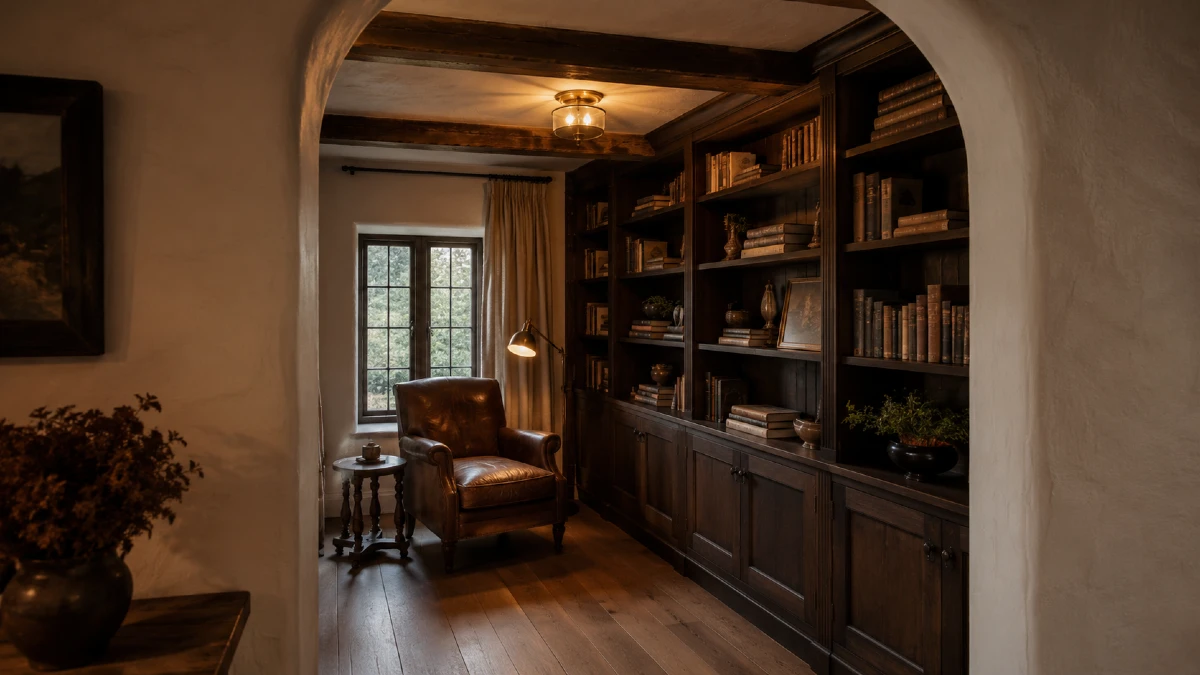
Cottage library does not need to be large. Spare corner can work. Start with shelves that reach close to the ceiling. Paint them a dark earthy shade or build them from stained oak.
Then add one comfortable chair and a small table.
That is enough.
Benjamin Moore selected Silhouette AF 655 as its 2026 Color of the Year. The shade combines rich espresso tones with charcoal notes, making it useful inspiration for a deep reading room color.
You do not need to paint the whole house this dark.
That would change the character completely.
A small library benefits from contrast because entering it feels different from walking through the lighter living spaces.
Lighting is important here.
Use a ceiling fixture for general light and a focused reading lamp or wall sconce beside the chair.
The books and wood already supply plenty of visual detail, so keep decorative objects limited.
13. Let the Garden Look Loose Without Letting It Become Messy
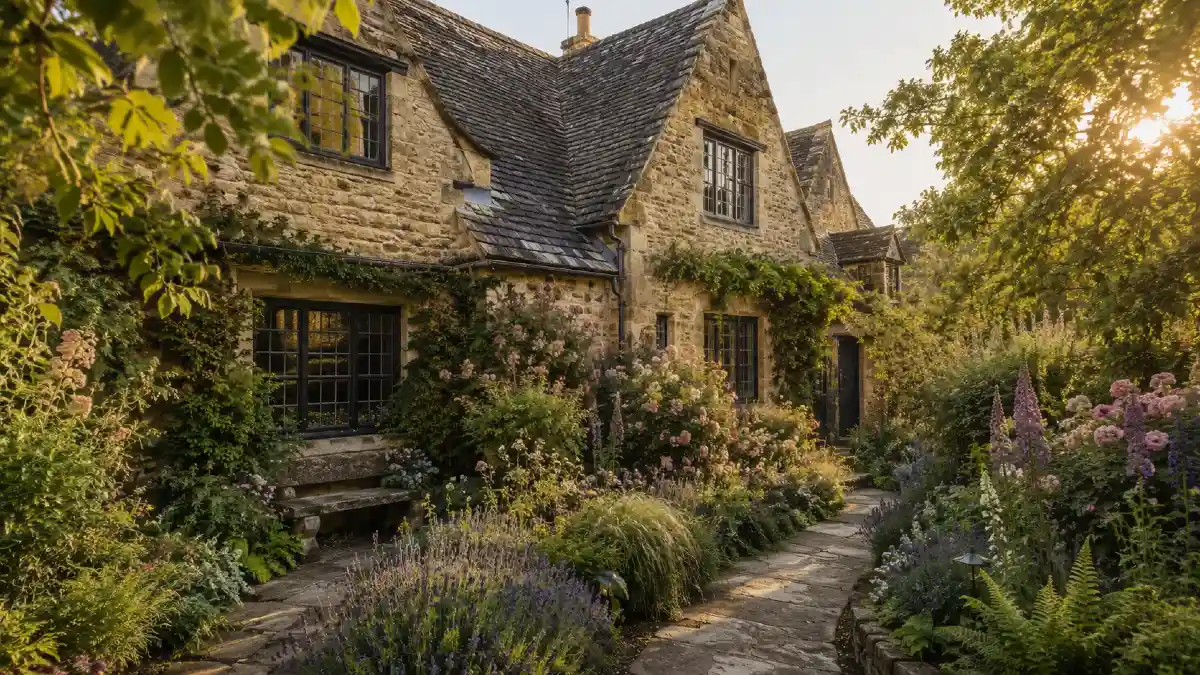
The cottage garden should soften the house.
It should not swallow it.
Start with curved paths instead of forcing everything into straight lines.
Plant in layers.
Low herbs and flowers can sit along the path. Medium plants can fill the center of beds. Roses, foxgloves, shrubs, and climbers can create height behind them.
Allow a little overlap.
That slight looseness gives cottage gardens their relaxed appearance.
But keep important building areas clear.
The RHS warns that vigorous climbing plants can reach guttering and roof tiles if they are not controlled. Ivy should also be trimmed away from windows, gutters, chimneys, roofs, and vulnerable wall finishes.
That means the prettiest cottage garden is usually managed more carefully than it first appears.
You want the planting to frame the front door, reveal glimpses of stone, soften the path, and pull your eye through the garden.
You do not want to spend every weekend rescuing the roof from plants.
14. Make the Cottage Most Beautiful After Sunset
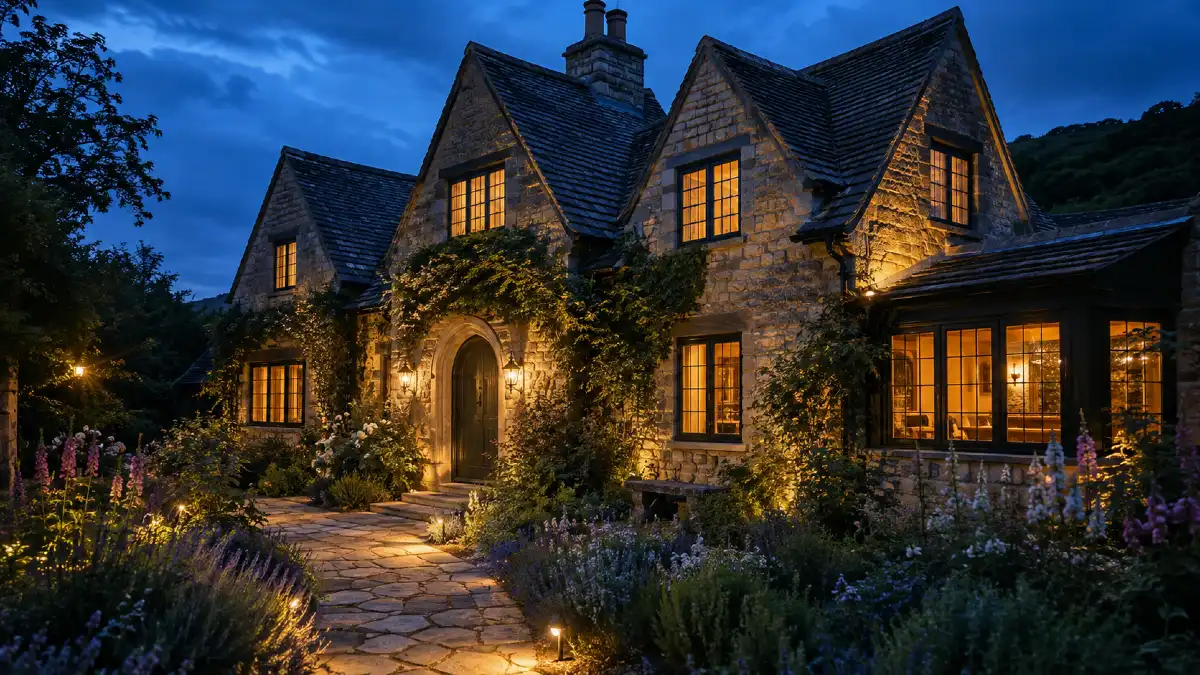
Storybook cottage should not lose its charm when daylight disappears. This is where layered lighting matters.
Let the windows glow softly instead of flooding every room with bright overhead light.
Schoolhouse recommends thinking about three broad lighting roles: ambient light for general brightness, task light where you work or read, and accent light for adding depth.
Use all three inside.
A pendant can light the kitchen table. Sconces can illuminate the bedroom and library. Lamps can soften the living room around the fireplace.
Outside, keep it quieter.
Pair of entrance lanterns and a few subtle path lights are usually enough. You still want to see shadows. They reveal the rough stone, uneven ivy, roof shape, and deep windows. The goal is not to turn the cottage into a glowing display.
It should feel like someone has made tea, lit the fire, and settled inside for the evening. That last scene may be the simplest.
It is also the one that makes the whole cottage feel alive.
The Best Storybook Cottages Feel Collected, Not Decorated
The most convincing storybook cottages do not depend on piles of vintage objects.
Their character starts with shape and material.
Stone walls create texture. An arched oak door softens the entrance. Exposed beams bring warmth overhead. Deep windows become useful places to sit. Muted paint, aged metal, warm lighting, and loose garden planting finish the picture.
You do not need all 14 ideas. Choose the details that work with your house. Start with one architectural feature and one natural material. Then give them room to stand out.
That simple approach can make an ordinary space feel warmer, older, and much more personal without turning your home into a cottage themed set.